Tuesday, March 6, 2018

[Grace] The Train Ride from Greymouth to Christchurch


Image result for greymouth to christchurch train map


Background:

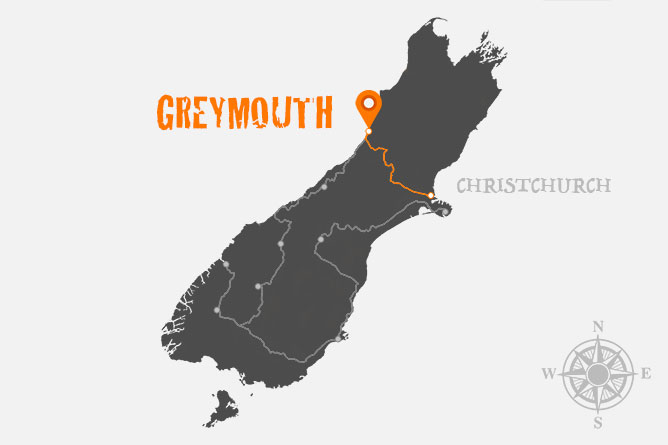
On Sunday, March 4th we were on the southern island of New Zealand and we took a train from Greymouth to Christchurch (see the map to the right).


The Train Ride:
An Underwhelming Account of Past Events
(with captions)


waiting for the train . 


finally boarding (and i thought these pics looked cool ¯\_(ツ)_/¯)


look @ dem cute boys


listening to some true bops & hydration game strong.


me being weird


wow look i got on this train legally and have the documentation to prove it


dark & moody shot of train going around a bend


you can't really tell but i'm hanging my head out the train window. i risked my phone to take this picture so please appreciate it thx.


nice lil ootd (outfit of the day) in train bathroom. i'm wearing a dress tied up into a shirt #fashionblogger


sleepy. ready to get off the train.

[Kate] My Thoughts on Kindles


In order to save space and minimize weight, we’re bringing mainly Kindles (or iPads with the kindle app, like I am doing) for reading.  Here are my thoughts on my only source of books (which, if you know me, is a big deal!):

Image result for kindleThings I Like About Kindles:

-They’re pretty compact and lightweight.  Well, compared to a heap of books they’re insanely so.  That’s the main reason they’ve come along for our trip.
-We can get books we want pretty quickly as long as they’re available at the library.  Instead of searching through bookstores we can look online.
-They’re pretty easy to use.  Well, once you get the general idea at least.
-They have a built in dictionary, so if you come across a word you don’t know you can just hold down on it and read the definition.  This can also sometimes work with character or place names in the story.
-You can make notes and highlight the text.  I don’t use this that often, but it can still be cool.  And sometimes you can see what other people often highlight in their text.

Things I Dislike About Kindles:

-You need to download books if you want to read them.  I understand the reason why, of course, but it can still be annoying because my iPad (which I am using as a kindle through the kindle app) has a bit of a problem with storage, considering all the movies and books I have downloaded onto it for this trip.
-They just don’t have the feeling of real books.  You can’t flip through the pages, so it can be harder to go back, and to know exactly how far in you are.
-Even though they are not so difficult to use, I do end up pressing the wrong thing sometimes and have to figure out how to get back to my page.
-They can freeze.  It really irks me when this happens.  Even though it’s normally not for very long, it’s infuriating for me.

Monday, March 5, 2018

[Kara] The New Zealand Campervan Phenomenon

As Seth and I were preparing for the New Zealand portion of our trip, we read a lot about people renting "campervans” to explore the country.  We don't really use the term campervan much in the US, but the idea of campervanning doesn't seem so strange to me.  RVs are prevalent and my brother Tristan has intermittently lived out of his Toyota Rav4 during his adventures.  (Check out his great website suvrving.com for all kinds of advice and expertise on how comfortably travel and camp out of your SUV.)

But I was still surprised by the sheer number of campervans and small RVs on the New Zealand roads.   What I didn't realize before we visited is that you can camp (or camp in your vehicle) for free on most public land in New Zealand—and that makes campervanning a pretty flexible way to see the country.

What I didn't expect at all, was the assortment of crazy looking campervans.  One of the most common campervan rental companies is named Jucy (pronounced like "juicy” I guess).  All of their vans are painted like this one.  We saw at least 20 of these a day.  Kate said she would NEVER be caught dead in a Jucy van.  You can check out the range of Jucy campervans here (with pictures of the floorplans so you can see how you'd fit in one of these guys).  https://www.jucy.co.nz/our-vehicles/camper-vans/


Once a day or so, we saw one of these vans that was graffitied and had a silly sentence painted on it.  These are from a company called named Wicked Campers.

They also offer campervans painted to look like the Scooby Doo Mystery Machine which we saw at least twice (but I never got a picture of).  Here's a link to the site where you can rent them so you can see I'm not making this up!  http://www.wickedcampers.co.nz/new-zealand-campervans/new-zealand-campers/mystery-machine-2-sleeper-camper.html

(What do you think the odds are that Wicked Campers actually have a license from Warner Brothers to use the Mystery Machine likeness?)


And occasionally, we saw something like this that was just painted crazy like this monkey car.  This minivan could belong to any regular family in NZ and their car almost wouldn't stand out.

We did feel a little left out of the campervan craze, but we were content to drive around in our rental car and sleep in motels rooms which were very reasonably priced (equivalent to the daily rental rate for a campervan), clean, spacious (compared to a campervan) and had kitchenettes so we could cook our own meals.  Plus, we could shower, which most of those campervanners couldn't do! (Though Tristan has a strategy for that.  Again, you should check out his website suvrving.com.)

Here's a picture of Seth and Cannon making pancakes in one of our motel rooms while the girls worked on homework.  Even a motel room can feel luxurious compared to a van!

Those jugs that look like they'd hold juice are actually
filled with dry pancake mix.  Add water and mix.  Pour into the hot pan.  So clever!


Sunday, March 4, 2018

[Seth] South Island Road Trip

For the past 5 days we have been driving north along New Zealand's Highway 6 and staying each night in a small town.  While spectacular (more on that later), there have been several challenges:
  1. Driving on the left hand side of the street.  Why have we not come up with a global standard for which side of the road to drive on?  It not only makes it nerve-wracking to drive, but I also am never certain which side of the sidewalk/trail/stairs to walk down.  And, since there are lots of tourists in New Zealand, everyone does it differently which compounds the problem.
  2. One lane bridges.  The vast majority of the bridges on Highway 6 have one lane (not one lane in each direction, but just one lane) which makes for an exciting game of chicken.
  3. Unusual road signs.  My favorite is the exclamation point.


    But these two were also great:


4.  My fellow passengers' quirks.  Grace's obsession with photographs, which means she is always leaning into one of her sibling's space get the right angle for a shot.  Kate's singing, for those of you that don't know, my daughter Kate has the tendency to just start singing to herself -- while often a charming trait, it is slightly less charming in the car with four other people.  Cannon/George's fiendish delight in bother his sisters and his constant movement.  And Kara's control over the one phone (very much like the one ring) that has data plan which allows her to be the final arbiter of all factual disputes.

Highway 6

Now for the drive, it is incredible.  Highway 6 extends from the northeastern corner of the South Island across the top of the island, then down the length of the island, initially along the West Coast and then across the Southern Alps and finally across the southland plains to the island's south coast (it has to cut inland in the south to avoid the southwest corner where Fjordland National Park is situated) and it covers and incredible variety of terrain.  We picked up the road in the south at Queenstown and drove to north to Westport -- a map of the South Island and Highway 6 is below with the segment that we travelled in red.


Other than in Queenstown, there were no traffic lights on the entire route (just roundabouts) and it was always a 2-lane road, except for the one lane bridges described above.  We travelled across three distinct segments -- the Southern Alps and mountain lakes, Fox and Franz Josef Glaciers, and the Coast. 

Southern Alps

As we crossed over the Southern Alps heading for the west coast, we passed by waterfall after waterfall feeding high mountain lakes that were bright blue (caused by the mica flakes in the schist rock that is so common in the region).  There were a number of hikes along the way, we particularly enjoyed the Blue Pools hike that ended at a rock beach where people had built hundreds of cairns.


The Blue Pools was a two mile hike over several suspension bridges (the bridges all have signs limiting the number of people on them which makes George/Cannon very nervous).  I keep telling him that there will be many more of these bridges in Nepal and they won't be made this well and they will definitely not have signs limiting the number of people on them.


The Glaciers

On the west side of New Zealand, there are two glaciers that come down to within a few miles of the ocean.  It is sort of a bizarre climate for glaciers.  The vegetation is almost tropical and the climate is very temperate.  There is a crazy amount of rain (12-15 feet per year).  The glaciers are in a quick retreat due to climate change but you can still hike to within a kilometer of the bottom of them. We visited one of them, Franz Josef Glacier.


The Coast

The final part of the drive was along the western coast.  It was very similar to driving the Pacific Coast Highway in California.  The views were incredible and there were miles and miles of beaches and rocky outcroppings.  The most spectacular of these were Punakaki Pancakes Rocks and Blowholes and Cape Foulwind (named by Captain Cook after he couldn't sail around it due to the wind rather than by an 11-year old boy).  


Punakaki Pancake Rocks and Blowholes.  Which given all of the lectures from Kara on geology (we have now resorted in using Geology puns to avoid future continued discussions, "Gneiss fact!"), I know were formed 30 million years ago from fragments of dead marine creatures and plants that landed on the seabed. Immense water pressure caused the fragments to solidify in hard and soft layers. Gradually seismic action lifted the limestone above the seabed. Mildly acidic rain, wind and seawater sculpted the bizarre shapes.


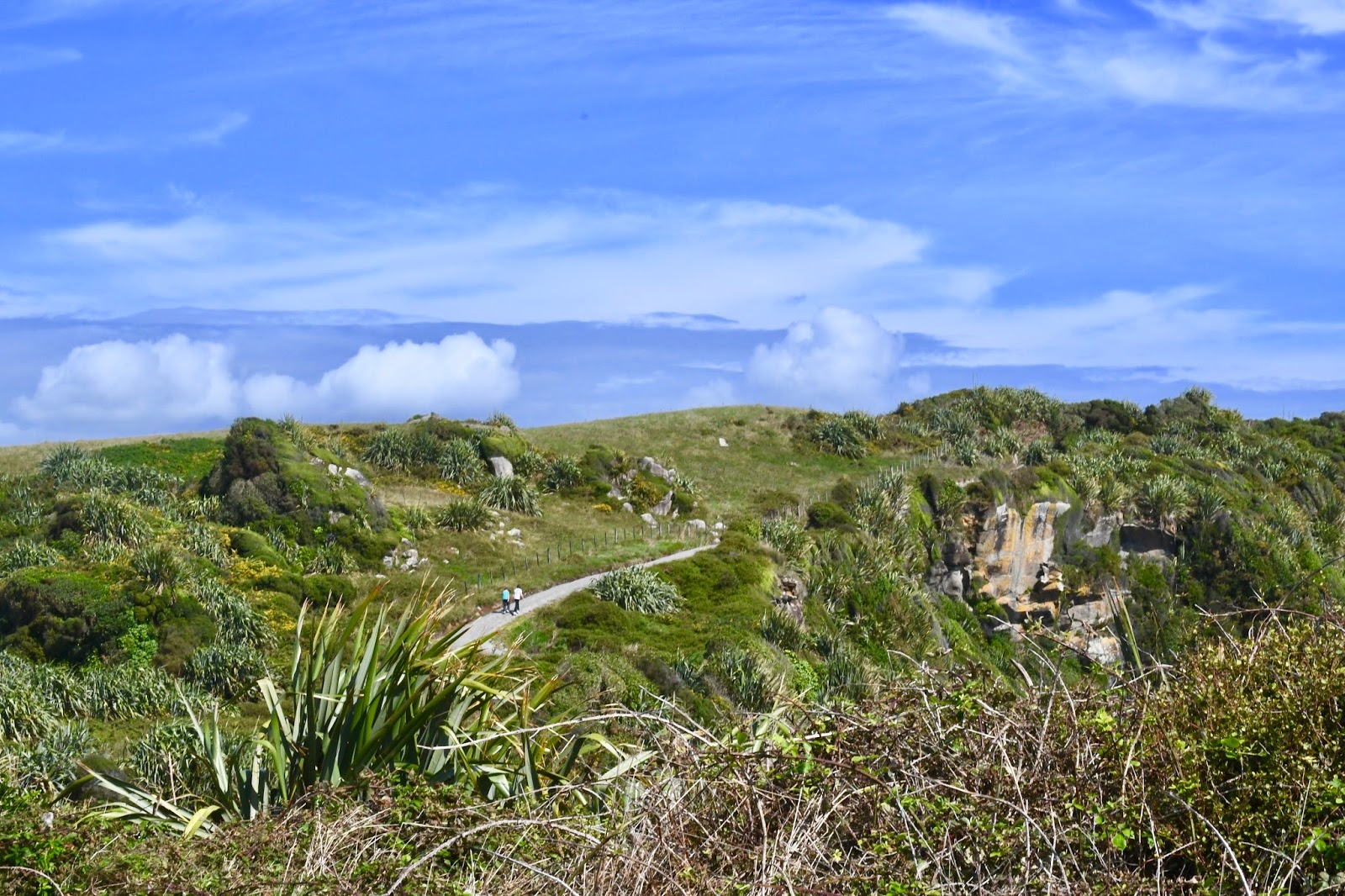
Cape Foulwind. We walked along the trail running out of the point and saw Fur Seals and lots of birds.  Allegedly there are penguins as well (as per the sign), but they successfully eluded the Beal family.  


[Kara] Schist or Gneiss?

Any geologists reading here?  Please don't be offended that I'm attempting to wade into your territory to discuss schist and gneiss.

We were first introduced to schist rock last week outside of Queenstown as we were driven down Skipper's Canyon Road, a precarious gravel track that leads into Skippers Canyon where the Shotover River runs.


We didn't get any great pictures of the schist in this valley because I didn't realize we would see it again.  But perhaps you can get a hint of the striations through this picture of Lighthouse Rock.  While we stopped to take this picture, we picked up a piece of schist off of the ground and it was very soft--the softest rock I've ever felt.  It looked similar to slate, but we easily scraped off material at the edges with our fingers as if it were wet particle board.  And after we touched it, our hands were covered in a fine glitter powder of mica.  It was obviously sedimentary rock, but our guide called it "sedimentary metamorphic."  What???  I'd never heard of that in 7th grade physical science, so I assumed the man didn't know what he was talking about.

BUT, I owe that guide an apology! 

A few days later, we were hiking a few hundred kilometers away at Franz Joseph Glacier on the west side of the South Island and we saw this very striated rock that looked like schist, but seemed as hard as granite (and there were granite and quartz stones on the ground around it).  So I had to do some research, and . . .

Now I know that sedimentary metamorphic is a real classification for rocks.  In fact, what I don't remember from 7th grade physical science (or didn't learn) is that metamorphic rocks all began life as sedimentary or igneous (or even other metamorphic) rocks and then were subjected to the overwhelming combination of temperature and pressure deep in the earth's crust that metamorphosed them (which changes the crystal structure of the rock, but not the chemical composition of it). So, the soft schist in Skipper's Canyon is metamorphic, but just not as metamorphosed and the harder schist at Franz Joseph Glacier.

The next problem I encountered as I researched was that there's another type of stone that similar to schist--it's called gneiss.  And some of the striated rock that we saw at Franz Joseph Glacier was gneiss (so said an interpretive sign near the foot of the glacier).  But how could I tell the schist from the gneiss?  Apparently, it's tough to do and even geologists can't do it easily all the time (so says the Internet).  Some of the characteristics that determine the difference include slaty cleavage, schistosity and gneissic banding. 

(I don't know what any of those words mean, but they sound amazing, don't they? And I don't care to research this any more and because I'm the homeschooling teacher, I can decide when we've learned enough.)

Kate is leaning against a bolder of either schist of gneiss near the foot of Franz Joseph Glacier.

In case you're interested in learning more, here are a couple of my sources:
http://www.columbia.edu/~vjd1/meta_rx.htm
https://www.gns.cri.nz/Home/Learning/Science-Topics/NZ-Geology/Rock-Types

P.S.  Yesterday we saw the Pancake Rocks of Dolomite Point near Punakaiki that are ALSO very striated.  But they are neither schist nor gneiss.  They are limestone.  According to an interpretive sign at the Pancake Rocks, scientists don't understand how or why they were formed in layers.

Pancake Rocks of Dolomite Point near Punakaiki

Friday, March 2, 2018

[Kate] New Zealand Powerful Women Homework Project

On this trip there are three main components of our homework. The math (which is completed online), posting on the blog, and our overarching project. This project is unique to each one of the three kids. We each picked a topic that interests us, and research that topic in the countries that we go to. The topic that I have chosen is powerful women.

What follows is what I discovered in my research concerning powerful women in New Zealand.  I found some of it really intriguing!

In New Zealand the native people are called the Maori.  Some women were powerful in that culture; they had significance to their religion and were a key part of the communities as a whole.  They kept their last names when they married, and there are even some records of women who became very powerful leaders in their tribe and community.  In any case, the Maori views are just one part of New Zealand culture.  As it was a British colony, there is a lot of British influence in the society.  They speak English, for instance, albeit with their own accent.  So it follows that many of the traditional views from British culture on women continue, at least somewhat, in New Zealand.  These views have been limiting in some years of Britain, viewing women as those with housework, rather like the stereotypes of women from early America (which again makes sense, as America started as British colonies as well).  When New Zealand was colonized it appears a lot of the British laws and ideas affected the view on women in Maori culture, significantly lowing their position.

However, New Zealand gave women the right to vote earlier than the United Kingdom and the United States.  In fact, when it did so in 1893 it became the first self-governing country that had the right given to all women.  There have been (as of 2017) three female Prime Ministers of New Zealand, the first being Jenny Shipley in 1997.

New Zealand’s current Prime Minister (the leader of government in a parliamentary government system) is also a woman (making her the third Kiwi female Prime Minister).  Her name is Jacinda Ardern, and she is only thirty seven years old.  Her age makes her the youngest ever leader of the New Zealand Labour party.  Not only that, but she became the leader of that party only two months before the election was set to take place.  Jacinda Ardern was an adviser to Helen Clarke, who was the second female Prime Minister of New Zealand, and also the first elected one (Jenny Shipley, the first Kiwi female leader, got her post after her predecessor resigned).  Until Jacinda Ardern’s became leader of the Labour party, the National party in New Zealand was far ahead in the election predictions, as it had been in the past for many recent elections.  Yet at her appearance in the forefront of politics, there was a wave of support for the Labour party.  This was referred to in one article written during the election as ‘Jacindamania.’

Even though during its period of colonization the value of women was decreased in society, New Zealand’s views are far beyond that now, as many significant women have risen to power, and as it has passed significant laws early on granting Women's Suffrage.

I found all this really interesting! I hadn't know this history beforehand, and it was something I enjoyed learning about.

Thursday, March 1, 2018

[George/Cannon] Bungee Jumping Part II

This is me before leaping (But about to)

This is the Kawarau Gorge where we jumped
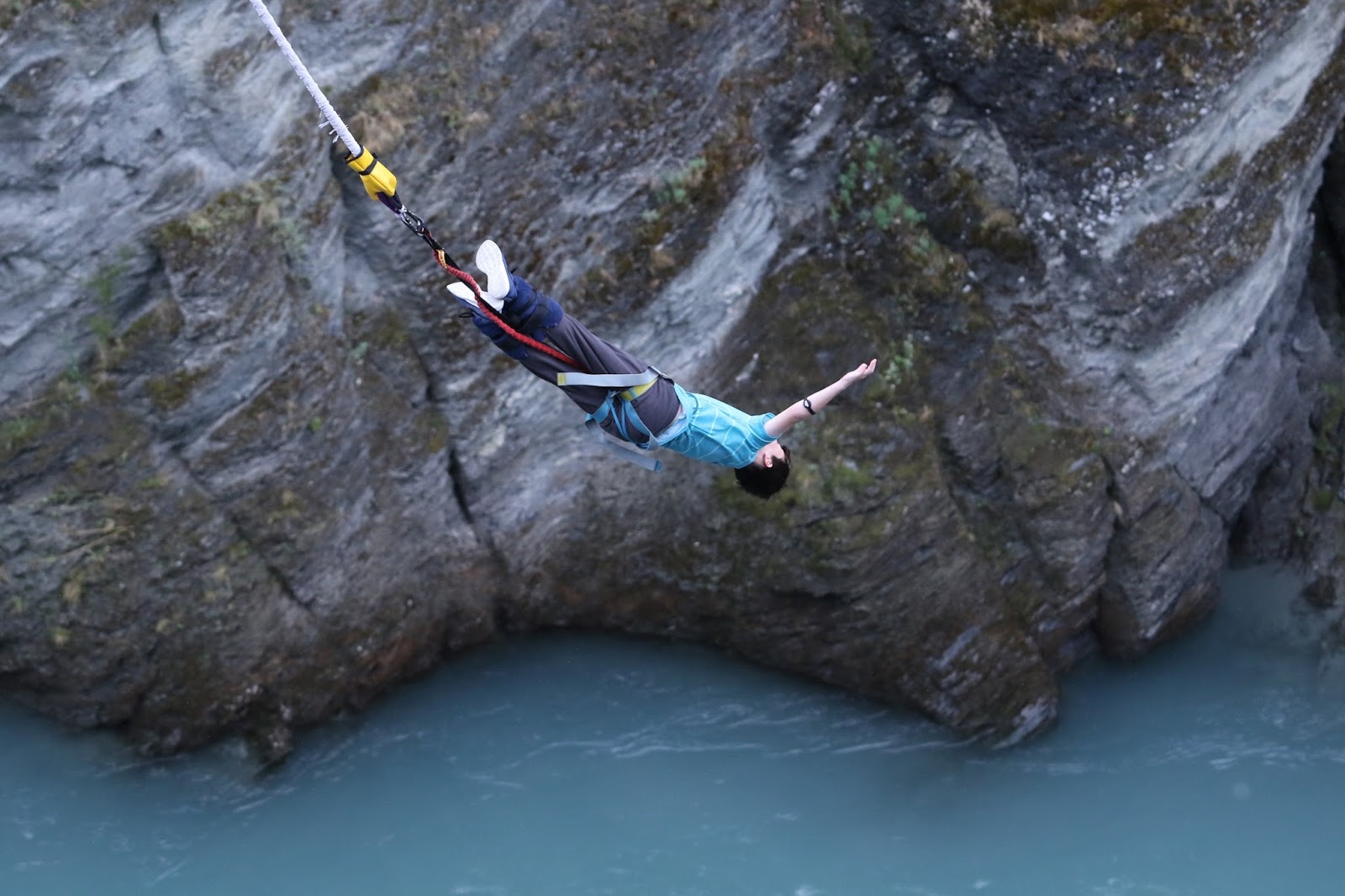
As you might of seen a couple of days ago I posted about my feelings on bungee jumping.  If you want to see that post check it out.  Anyway earlier today part of my family (including me) drove to a bridge to jump off of it.  I will admit I was terrified, my legs were legitimately shaking, because I was going to fall 120 feet and then be yanked up by a cord.  Assuming that I would survive the fall of course.  Yeah, well I was up there looking down.  It was high.  As I got into my harness my legs started shaking.  Then I was up the platform looking down.  The guy said "3, 2, 1" then I jumped.  At first it felt like a normal drop, but then I started gaining momentum.  Then all of a sudden I was yanked up by the cable.  I went up 15 feet then down 15 feet.  This repeated several more times each becoming progressively smaller.  Then someone in a boat below help out a long pole to me.  I grabbed it and was pulled onto the boat. 

Looking back on this I think that my original thought of me liking it was false.  I didn't hate it but eh feeling of falling wasn't for me.  But it was a fun experience and I can tell people about it. :)

This is me jumping (proper ninja mode)

I love this because if you can see my face I look totally chill and unconcerned


This is me bouncing around upside-down
This is me being picked up by the boat after jumping